"deva-dvija-guru-prājña-pūjanaṁ śaucam ārjavam brahmacaryam ahiṁsā ca śārīraṁ tapa ucyate" - Bhagvat Gita 17.14
Translation: “Worship of the Supreme Lord, the twice-born (the wise), the spiritual master, and the elders; cleanliness, straightforwardness, celibacy, and non-violence- these are declared as the austerity of the body.”
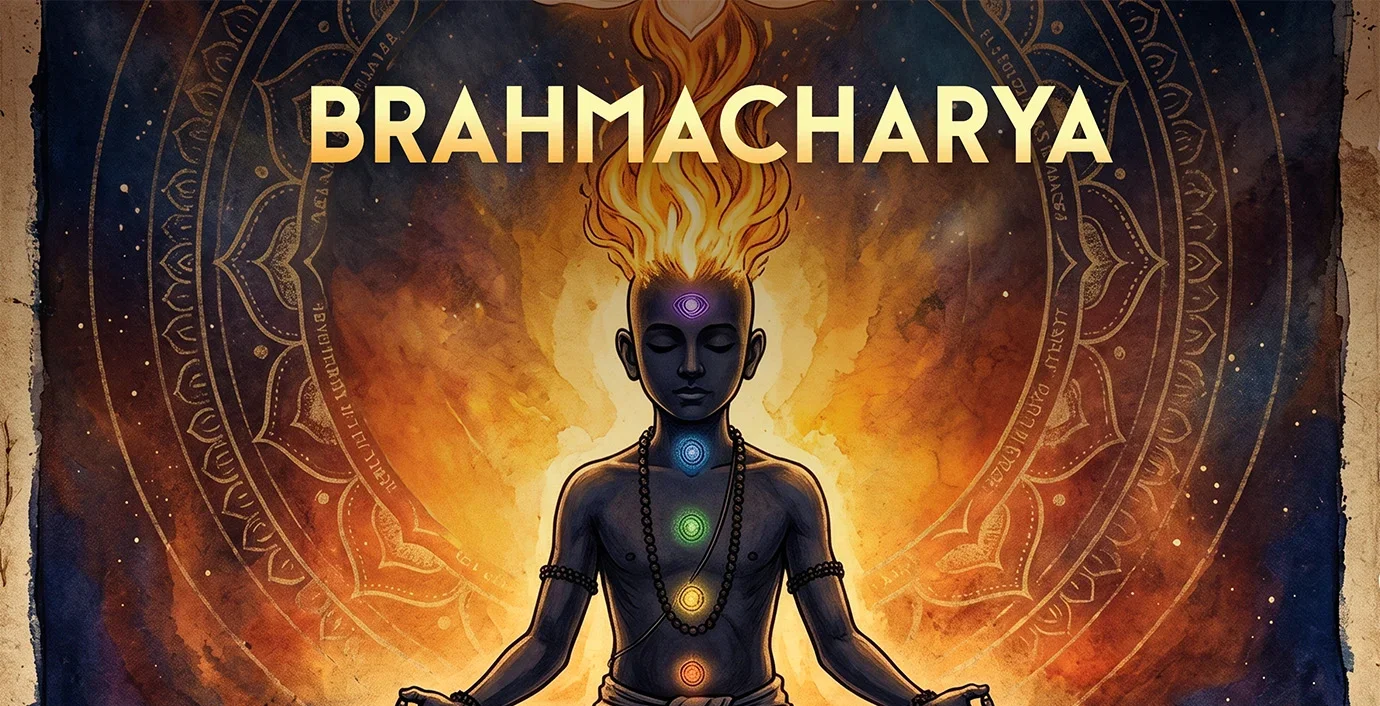
As Srila Prabhupada explains - Brahmacharya means directing all bodily energy toward Krishna consciousness by controlling the senses.
What is Brahmacharya?
Brahmacharya is a means of achieving the highest possible purification of the human body, enabling one to recognize the true meaning and purpose of life. It also means walking on the path of Krishna-Consciousness, moving towards infinity (Shri Krishna). As described by His Divine Grace A.C. Bhaktivedanta Swami Srila Prabhupada, it literally means “acting on the spiritual platform”. He emphasized that engaging in Brahmacharya serves the Supreme Lord, and that rather than merely seeking an artificial suppression of worldly, materialistic desires, one who observes Brahmacharya with true devotion surely attains the mercy of the Lord.
The Word Brahmacharya comes from two Sanskrit roots:
- Brahma: The Absolute Truth of Life, The Infinite and Supreme Consciousness
- Charya: To Walk, To Move, Way To Conduct Oneself
“brahmacharati iti brahmachari, tasya bhāvaḥ karma vā Brahmacharya” - (Chandogya Upanishad 8.5.1)
Translation - “Brahmacharya means to move and live entirely within Brahman - the Supreme Consciousness.”
In essence, Brahmacharya is not a restriction; it is a divine directive through which one can transform one's life and achieve moksha by fulfilling one's duties.
Types of Brahmacharya
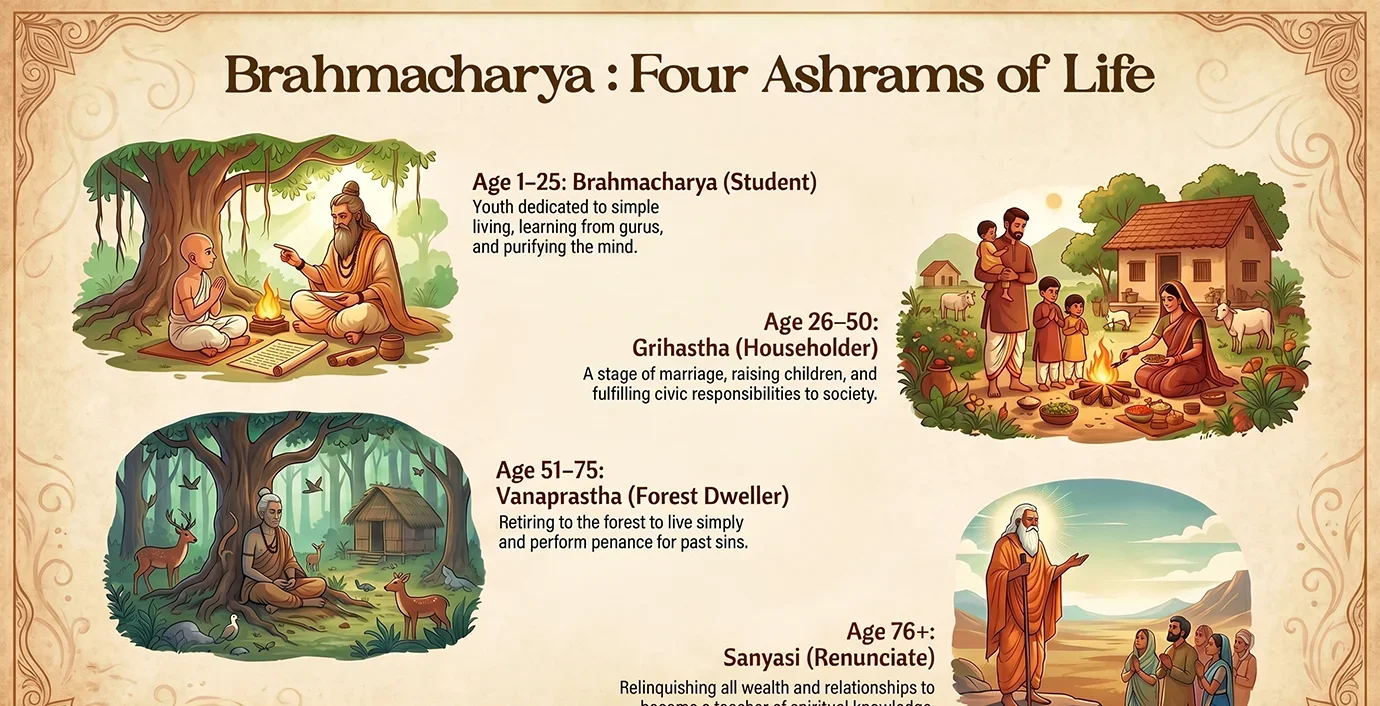
According to various Vedic philosophies and spiritual traditions, Brahmacharya is understood as the practice of directing one’s life and energy toward the service of the Lord. In traditional scriptures and different religious faiths, there are distinct types of brahmacaris, classified by their vows and the duration of celibacy.
1. As of Smritis (Hindu Scriptures)
1. Savita Brahmacharya
"The first is called sāvitra, which refers to a brahmacārī who, after initiation and the sacred thread ceremony, must observe at least three days of celibacy."
Savita is a short-term, initial vow to follow strict celibacy after a student’s sacred thread (upanayana) ceremony. For example, a young Brahmin student may control his senses, mind, and speech for at least three consecutive days, helping him transition to a dedicated life guided by the Guru's teachings.
Why Should We Practice Brahmacharya?
Brahmacharya is the practice that helps us realize the true aim of our birth in this material world. Like, if one is seeking to know the true meaning of one's life, brahmacharya helps attain the highest state of consciousness, offering vital nourishment and vigor to the brain.
Each person is potentially divine, with the manifestation of the Supreme Lord. In addition, by practicing the Brahmacharya principle, one can balance all aspects of life through speech, action, and desires.
"brahmacārī carati veviṣad viṣaḥ sa devānām bhavaty ekam aṅgam" - Rigveda (10.109.5)
Translation: "He who leads the life of a Brahmachari, adoring all the Gods, becomes one limb of the Gods themselves."
Brahmacharya Yoga
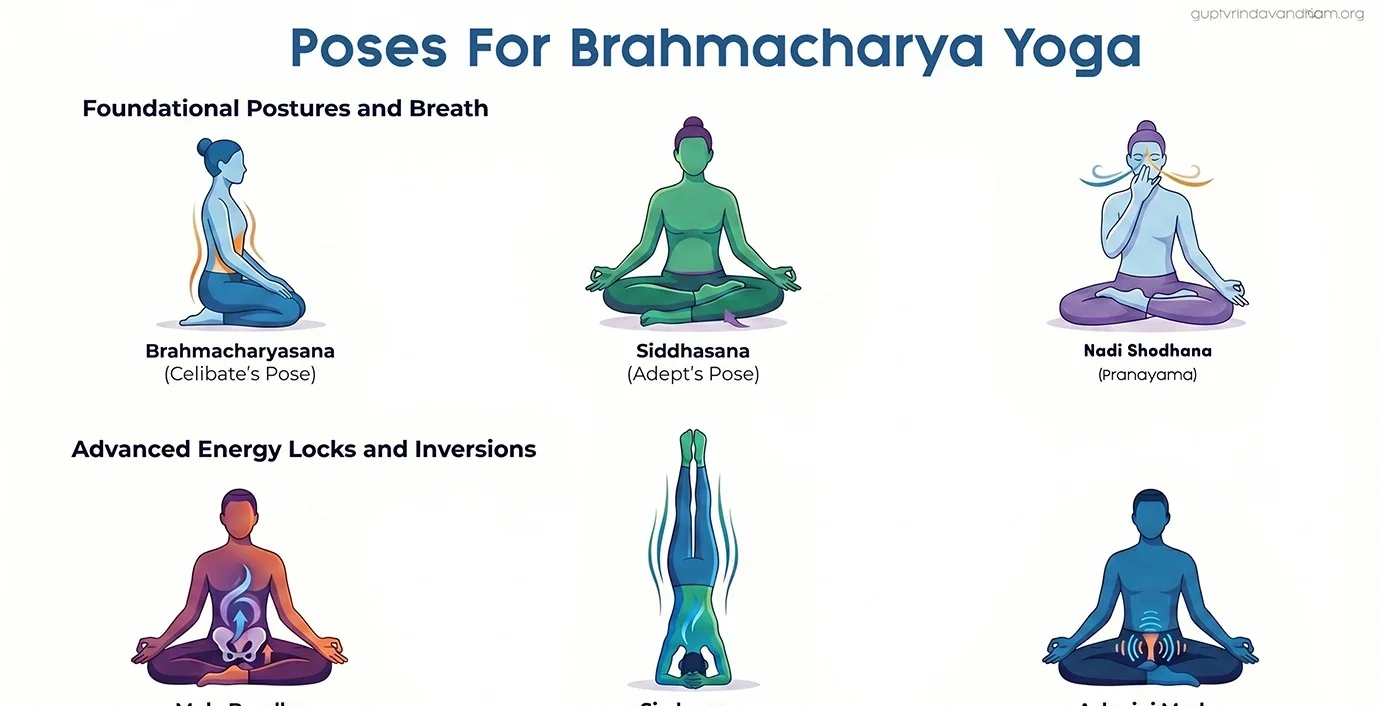
Brahmacharya is seen as the fourth Yama (ethical restraint) in classical yoga philosophy. According to various yogic texts, Brahmacharya is not forced celibacy but rather a practice of energy conservation.
Different Yoga Practices for Brahmacharya
| Yoga Practice | Description |
|---|---|
| Brahmacharyasana (Celibate's Pose) | Sit between your heels. Calms the mind and reduces sexual urges. |
| Siddhasana (Adept's Pose) | Best meditation posture for celibates. Pushes energy upward naturally. |
| Mula Bandha (Root Lock) | Tighten the pelvic floor. Stops energy from flowing downward and wasting. |
| Pranayama (Nadi Shodhana) | Alternate nostril breathing. Steadies the mind and reduces sensory cravings. |
| Sirshasana (Headstand) | Flips the body to send energy to the brain. Builds mental clarity and ojas. |
| Ashwini Mudra (Horse Gesture) | Contract and release the root muscles. Strengthens the base and lifts energy upward. |
Brahmacharya vs Celibacy: Key Differences
| Feature | Brahmacharya | Celibacy |
|---|---|---|
| Primary meaning | The Path of the Lord | Discarding particular activities like (sexual, lustful thinking) |
| Core Focus | Controlling all senses (mind, speech, and actions) | Refraining from sexual intercourse and physical intimacy. |
| Goal | Spiritual awakening, energy conservation, and self-realization | Can be practiced for various reasons (personal, religious, and practical) |
| Application | Can be practiced in different stages | Generally binary; either practicing or not. |
| Origin | Ancient Vedic texts and Yogic philosophies | Appears from different religions and secular frameworks |
Common Misconceptions About Brahmacharya
Brahmacharya is seen as a way or a rigid vow of reducing physical celibacy, but it is totally wrong and incorrect. Its origin and reverence are evident in Yogic and Ayurvedic texts, making it a philosophy that helps bring life to the end goal in every human form. Below are some of the most common myths:
- It’s not about physical celibacy
- It is not necessary to forbid marriage and family life
- Suppression of the desired goal is not the main aim
- It is a punishment with a joyless existence
Conclusion
Lastly, today’s generation needs to understand the true meaning of Brahmacharya, as several misconceptions obscure its benefits. It is beyond physical celibacy and enhances the focus of the mind, vitality, by redirecting the sexual energy mainly for the procreational process only.
Living a life of Brahmacharya is not bad; it is the most powerful gift of the Lord through which humans can attain the highest form of consciousness.
Adapted from the Gupt Vrindavan Dham blog: Brahmacharya: Meaning, Types, Benefits, Yoga, Four Ashrams.