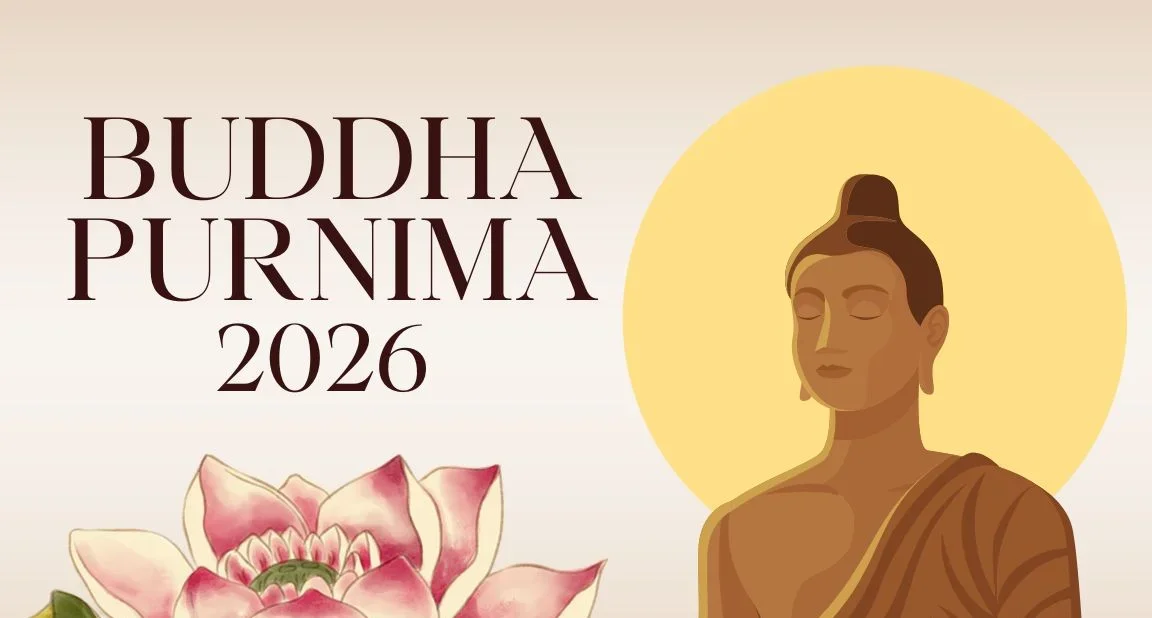
Buddha Purnima 2026 will be celebrated on Friday, May 1, 2026. In Sanatan Dharma, Lord Buddha is revered as the 9th Avatar of the Supreme Lord, and this day is also marked as the Kurma Jayanti (the appearance day of the Turtle Avatar of Lord Vishnu).
Moreover, as this day marks the birth and enlightenment day of Lord Buddha, this day occurs on the full moon day in the month of Vaishakha. This auspicious day reminds us the ultimate power of Dharma, self-discipline, and the eternal guidance of the Illuminated being.
कलौ दोषनिधे राजन् अस्ति ह्येको महान् गुणः ।
कीर्तनादेव कृष्णस्य मुक्तसङ्गः परं व्रजेत् ॥
However, in Kaliyuga, surrendering unto the supreme Lord Shri Krishna and by chanting Hare Krishna Mahamantra, one can practice and offer respect to Lord Buddha in a devotional and pure manner.
Devotees must observe the Buddha Purnima festival with pure intent and love to gain the blessings of Lord Buddha. This guide will help you know how to celebrate Buddha Purnima and what the significance of this day is, making it one of the most auspicious days in the Hindu calendar.
Buddha Purnima 2026 Date & Muhurat Timings
Buddha Purnima, which falls in the Vaisakha month, is celebrated as the birth anniversary of Lord Gautam Buddha. This year, in 2026, it will be the 2588th birth anniversary of Lord Buddha, as per the Panchang. The date and tithi for this auspicious festival are:
- Buddha Purnima 2026 Date: Friday, 1st May, 2026
- Purnima Tithi Begins: 09:12 PM on Apr 30, 2026
- Purnima Tithi Ends: 10:52 PM on May 01, 2026
- Shubh Muhurat Timings (1st May):
- Brahma Muhurat: 04:15 AM to 04:58 AM
- Abhijit Muhurat: 11:52 AM to 12:45 PM
History of Buddha Purnima
Buddha Purnima is an auspicious day, which marks the birthday of King Siddhartha Gautam, later known as Lord Buddha. He was born in Nepal, Lumbini, in the 6th century BCE. He had a life full of luxury from the day he was born, but when he reached his 20s, he abandoned his magnificent manor and aimed to start a journey that would give him the explanations and reasons behind the sufferings of human life.
During his journey, he examined the four sights of human suffering: an old man, a sick person, a corpse, and a monk, which helped him gain knowledge about the inevitability of sickness, death, and ageing. Around the age of 35, Gautam Buddha attained enlightenment from nature and became Lord Buddha or the Awakened Lord.
After that, for his lifetime till the age of 80, he addressed the values of Dharma and guided people on the path of enlightenment. Three significant landmarks marked the significance of Lord Buddha, Buddha Purnima, celebrated on the 1st full moon day of Vaishakha month, truly showcase the birth, knowledge, and redemption of Lord Buddha. This day was guided by the World Fellowship of Buddhists in the month of May around the year 1950.
Significance of Buddha Purnima
The significance of the Buddha Purnima festival is a reflection of the life Lord Buddha chose to find answers about human suffering. He was rich, had a life of luxury, yet he chose to gain the highest level of knowledge, so that he could guide mankind towards the path of enlightenment.
This day is referred to as Buddha Purnima in India, as it falls on the full moon day (Purnima) in the month of Vaishakha. Also, he was revered as the 9th avatar of Lord Vishnu in India; this day became more devotional and auspicious for the devotees. However, Buddhist communities do not recognise Gautam Buddha as an incarnation of Lord Shri Hari; they view him as an historical teacher who came to show the path of enlightenment to fellow mankind.
Siddharth Gautam was a charming prince and was married to Princess Yashodhara at a very young age. After marriage, Siddharath soon became a father, and one day, when he was travelling in his magnificent chariot, he came across an old man who was ill, had a lifeless body, and was suffering from several diseases. Soon after this scenario, he was transformed and left everything; he started his enlightenment journey of finding all the causes related to death and human suffering.
Core Teachings of Lord Buddha
Lord Buddha, also known as Shakyamuni Buddha, is the founder of Buddhism religion. Attained enlightenment under the Bodhi tree, he was the most prominent figure in history who spread wisdom and helped billions of people in ending their suffering and in achieving liberation from suffering.
After attaining Nirvana, he travelled to the holy city of Banaras to spread his learning amongst the five holy men, who agreed and followed the path told by him. After that, for more than 45 years, Lord Buddha stayed consistent and started to spread his teachings all over India.
Let's take a look at some of the crucial teachings Lord Buddha left for us humans, to act with humility and compassion, and to make society better for all living beings.
1. Nothing is lost in the Universe (Ahimsa)
The first universal truth Lord Buddha found was that nothing in the universe is lost; everything is connected. For example, he stated, if humans try to destroy something around them, they destroy themselves. Likewise, if we lie to someone, it means that we are lying to ourselves only. With this truth, Lord Buddha and his disciples acknowledge that hurting other creatures in this world is like we are hurting our soul. Throughout his journey, he never killed animals and developed compassion around the society for other living beings in society.
2. Everything changes (Anicca)
The second universal truth Lord Buddha identified was that everything changes and keeps on changing constantly. Change is the only constant thing in this world. In ancient times, many different forms of life existed, whereas today, humans are the dominant species. Life is like a flowing river; it keeps on flowing. All things, whether they are physical or mental, are constantly changing, temporary, and flowing. Nothing in this universe is ever-lasting.
3. Law of Cause and Effect (Dukkha)
“The kind of seed sown will produce that kind of fruit.
Those who do good will reap good results.
Those who do evil will reap evil results.
If you carefully plant a good seed,
You will joyfully gather good fruit.”
Dhammapada
The third universal truth Lord Buddha acknowledged was that all the sufferings of human beings are the fruits of their own karma. If someone does good things, then good things will come to them. If someone does evil things, then evil things will come to them. Karma always returns. Most of the religions in the world believe in Karma, and in Hinduism and Buddhism, Karma has a very crucial role in one's life.
Buddha Purnima 2026 is a divine opportunity for devotees to attain the teachings of Lord Buddha and immerse into pure peace, compassion, and inner wisdom. On this auspicious day, attain mental peace and cultivate a society full of love and purity.
Whether you are seeking to celebrate Buddha Purnima at your home or planning to visit the pilgrimage places, some of the Buddha Purnima rituals listed above in this article are best to observe this day with pure devotion. May this Buddha Purnima bring you and your family clarity and prosperity, with a heart full of kindness.
Adapted from the Gupt Vrindavan Dham blog: Buddha Purnima 2026: Date, Significance & Celebration Guide.