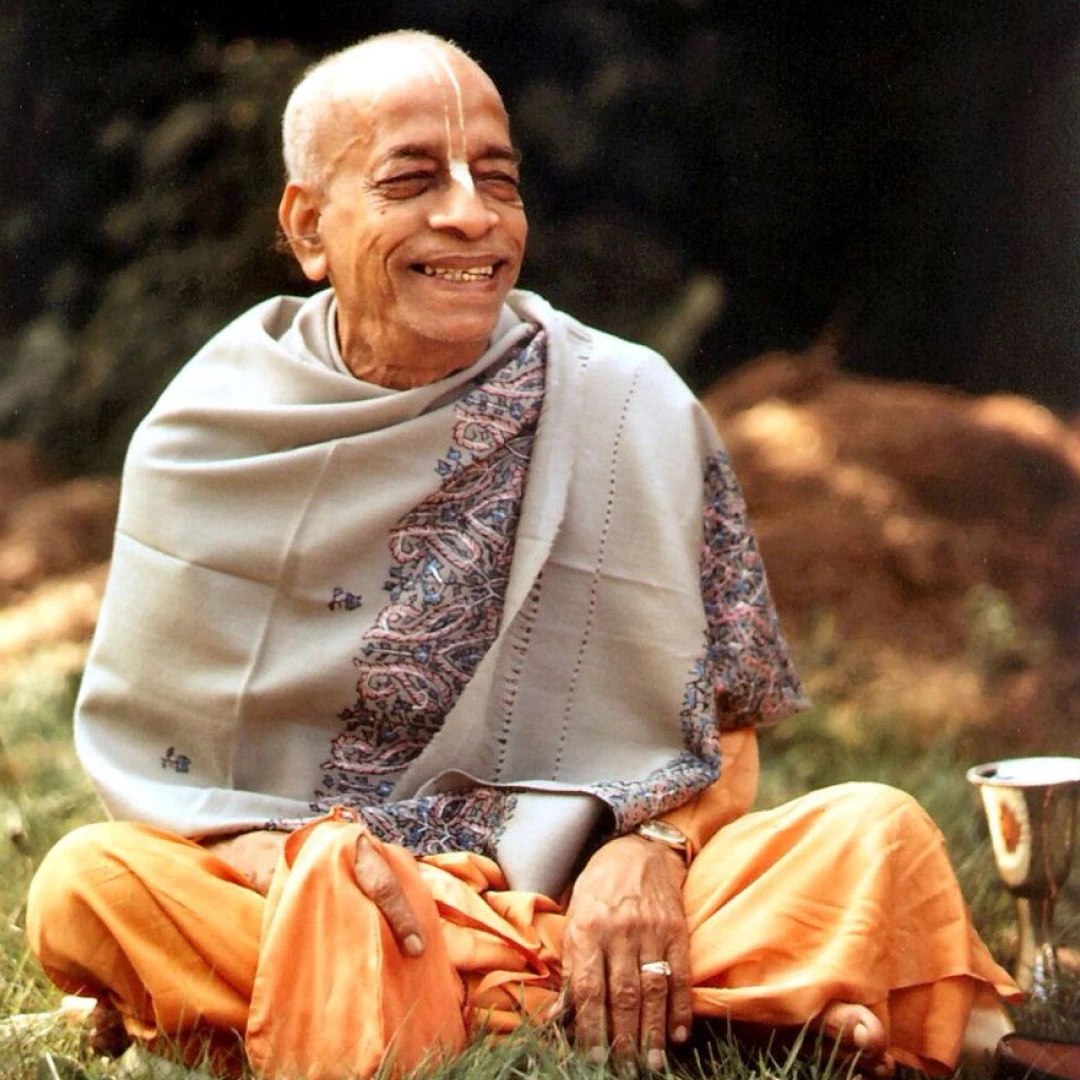
Ye Suddha Bhakta Ye Krsna Tomate Satata
Ye Suddha Bhakta Ye Krsna Tomate Satata
A.C. Bhaktivedanta Swami
Anasrita Karma Phal Sei Mukhya Hay
Bhajan
Gitar Gan
43 verses · Lyrics only · English, Hindi
Anasrita Karma Phal Sei Mukhya Hay
A.C. Bhaktivedanta Swami
sri-bhagavan kahilen: anasrita karma-phal sei mukhya hay taha vina sannyasi ki yogi kichu nay karma-tyag nahe mukhya karma-phal tyag daihik cesta se tyag nahe ta' samyak tai se sannyasi yogi saman ye kram karma-phal tyag vina dui sei bhram
The Blessed Lord said: One who is unattached to the fruits of his work and who works as he is obligated is in the renounced order of life, and he is the true mystic: not he who lights no fire and performs no work.
asmnyasta sankalpa vina nahe yogi vahye matra kriyahin antare se bhogi
What is called renunciation is the same as yoga, or linking oneself with the Supreme, for no one can become a yogi unless he renounces the desire for sense gratification.
sab yog hay siddha karma se karan aruruksa muni sei suna vivaran yogete arudha sei samata karan sadhaker krama pantha yoganusaran
For one who is a neophyte in the eightfold yoga system, work is said to be the means; and for one who has already attained to yoga, cessation of all material activities is said to be the means.
indriyartha yada karma acarita nay sarva sankalpa-sunya sannyasi se hay yogarudha se avastha sastrera nirnay se avastha mukta path karaha asray
A person is said to be have attained to yoga when, having renounced all material desires, he neither acts for sense gratification nor engages in fruitive activities.
anasakta visayete yatha karma drdha samsara se kup hate nija atma kada atmake uddhar kara atmara ucit atmake nahi kabhu kara abasad atmai atmar bandhu atmai se ripu atmara satru ye hay hiranyakasipu
A man must elevate himself by his own mind, not degrade himself. The mind is the friend of the conditioned soul, and his enemy as well.
ye jan jinila nija man atmajita se man ye bandhu taha sastrete kathita ajita ye man sei man nija satru apakari hay sada viruddha vipaksa
For him who has conquered the mind, the mind is the best of friends; but for one who has failed to do so, his very mind will be the greatest enemy.
prasanta ye man sei sarvadai jita atmajita man paramatma samahita grisma sit yata duhkha man apaman jita man yar tar sakali saman
For one who has conquered the mind, the Supersoul is already reached, for he has attained tranquility. To such a man happiness and distress, heat and cold, honor and dishonor are all the same.
nija trpta sei man jnan vijnanete kutastha vijitendriya nijera karyete sama lostra svarna yar yukta hay yogi sakala avasthate ye sarvadai tyagi
A person is said to be established in self-realization and is called a yogi [or mystic] when he is fully satisfied by virtue of acquired knowledge and realization. Such a person is situated in transcendence and is self-controlled. He sees everything--whether it be pebbles, stones or gold--as the same.
suhrd mitra nispaksa bandhu kimba ari sakaler prati yini sama bhuddhi kari madhyastha kimba sadhu ye papiyasi hay sakaler prati samya sresthata prapay
A person is said to be still further advanced when he regards all--the honest well-wisher, friends and enemies, the envious, the pious, the sinner and those who are indifferent and impartial--with an equal mind.
ye yogi satata thaki ekaki nirjane nirasi aparigraha cittera yatane samadhistha haye thake adhika samay vairagi tahar man vasibhuta hay
A transcendentalist should always try to concentrate his mind on the Supreme Self; he should live alone in a secluded place and should always carefully control his mind. He should be free from desires and feelings of possessiveness.
pavitra sthanete basi nijasan upare celajin vastra asanadi paropare ati ucce nahi base ati nice nahe sthir man haye eva yogabhyase rahe ekagratah man kari yata cittendriya yogabhyas kare muni visuddha hrday
To practice yoga, one should go to a secluded place and should lay kusa-grass on the ground and then cover it with a deerskin and a soft cloth. The seat should neither be too high nor too low and should be situated in a sacred place. The yogi should then sit on it very firmly and should practice yoga by controlling the mind and the senses, purifying the heart and fixing the mind on one point.
deha sir griva tin samana kariya acala avastha dhir bhavete basiya nasikar agra-bhag satata dekhiya anya yata drsya-vastu kichu na dekhiya prasantatma bhay nai brahmacari vrata samyamita man yeva amatei rata
One should hold one's body, neck and head erect in a straight line and stare steadily at the tip of the nose. Thus, with an unagitated, subdued mind, devoid of fear, completely free from sex life, one should meditate upon Me within the heart and make Me the ultimate goal of life.
se bhave ye yoga sadhe niyata manas sadatma sei yogi amrta paras nirvan parama santi hay adhikari phire yay mama dhame yatha lilahari
Thus practicing control of the body, mind and activities, the mystic transcendentalist attains to the kingdom of God [or the abode of Krsna] by cessation of material existence.
ati-bhoji anahari yoge siddha nay ati-nidra ati-jagi suna dhananjay
There is no possibility of one's becoming a yogi, O Arjuna, if one eats too much, or eats too little, sleeps too much or does not sleep enough.
yukta-bhoji vihara se yukta karma cesta yukta nidra yukta jagi yoga parasrsta
He who is temperate in his habits of eating, sleeping, working and recreation can mitigate all material pains by practicing the yoga system.
yatatma viniyata citta atma-tusta nisprha ye sarvakame sei yoga-pusta
When the yogi, by practice of yoga, disciplines his mental activities and becomes situated in Transcendence--devoid of all material desires--he is said to have attained yoga.
yatha dip vina vayu sthir bhave thake uttama upama sei yogira nisthake
As a lamp in a windless place does not waver, so the transcendentalist, whose mind is controlled, remains always steady in his meditation on the transcendent Self.
yogira se atma-sthir yoga sadhanete yogatmana tar nam yog abhyasete visay bhoger uparati yogira praman niruddha se yog-seva siddhira nidhan atmaram yada tusta atmar darsane siddha sei yogi hay yogera sadhane satya ye sukh taha indriyatita yev sei nahi jane asthira tattvatah ye sukh haile labh sarva-labh hay anya sab yata labh kichu kamya nay yahate haile sthita guru duhkhe ati asthira na hay thake atala vicyuti yog sadhi se avastha yadi labhya hay astanga yoger siddhi tahare kahay
The stage of perfection is called trance, or samadhi, when one's mind is completely restrained from material mental activities by practice of yoga. This is characterized by one's ability to see the self by the pure mind and to relish and rejoice in the self. In that joyous state, one is situated in boundless transcendental happiness and enjoys himself through transcendental senses. Established thus, one never departs from the truth and upon gaining this he thinks there is no greater gain. Being situated in such a position, one is never shaken, even in the midst of greatest difficulty. This indeed is actual freedom from all miseries arising from material contact.
utsaha dhairya ar nilaya atmika yog-siddhi lagi chadi nirveda prapika sankalpa samasta dvara na haye kincit man dvara indriyake kariya vijit
One should engage oneself in the practice of yoga with undeviating determination and faith. One should abandon, without exception, all material desires born of false ego and thus control all the senses on all sides by the mind.
krame krame uparam visaya bhogete atmasthita man kari virama cintate
Gradually, step by step, with full conviction, one should become situated in trance by means of intelligence, and thus the mind should be fixed on the Self alone and should think of nothing else.
asthira cancal man yatha yatha dhay cesta kari sei man vasete rakhay atmara vasete man sadai rakhibe cancal svabhava tar sodhana karibe
From whatever and wherever the mind wanders due to its flickering and unsteady nature, one must certainly withdraw it and bring it back under the control of the Self.
prasanta haile man sukh uttam yogir santa hay rajogun nispap sarir nispapa haile sei sattva gune sthita brahma-bhuta nam tar suddha samahita
The yogi whose mind is fixed on Me verily attains the highest happiness. By virtue of his identity with Brahman, he is liberated; his mind is peaceful, his passions are quieted, and he is freed from sin.
vidhauta samasta pap yogi akalmasa sukhe brahma samsparsa se kramasa kramasa brahma sukhe magna hay se yogi takhana prakrta gunadi tyaji brahma anubhava brahma sparsa kiva hay kemane ta jani sarva-bhuta brahme darsan sarva brahma jani
Steady in the Self, being freed from all material contamination, the yogi achieves the highest perfectional stage of happiness in touch with the Supreme Consciousness.
sarvatra saman drsti yog-yukta atma samadhistha sei yogi dekhe paramatma
A true yogi observes Me in all beings, and also sees every being in Me. Indeed, the self-realized man sees Me everywhere.
se dekhe amare sab stavara jangame anya drsti nahi tar nirguna sangame se hay amar premi ami hai tar nirasa sukna tarka nahe vyavahar
For one who sees Me everywhere and sees everything in Me, I am never lost, nor is he ever lost to Me.
sarva-bhuta-sthita dekhe sarvatra amare bhajane asthita haye sevaye se more se yogi nikhila bhave sarvatra thakiya amate vasaye nitya amare bhajiya
The yogi who knows that I and the Supersoul within all creatures are one worships Me and remains always in Me in all circumstances.
vasudha kutumba tar keha nahe par prakrta vicara nai svpar apar nija sukha nija duhkha anyete vyavahar sei se samanadarsi sarvatra pracar
He is a perfect yogi who, by comparison to his own self, sees the true equality of all beings, both in their happiness and distress, O Arjuna!
arjun kahilen: apani ye yoga varta kahilen amare he madhusudan! taha na sambhave more mor mana cancala se asthira se mati ataeva bujhi ami asambhava gati
Arjuna said: O Madhusudana, the system of yoga which You have summarized appears impractical and unendurable to me, for the mind is restless and unsteady.
he krsna jana na kiva pramathi manere ati balavana sei saba panda kare tahara nigraha mani ati suduskara vayu rodha yatha hay atyanta prakhara
For the mind is restless, turbulent, obstinate and very strong, O Krsna, and to subdue it is, it seems to me, more difficult than controlling the wind.
sri-bhagavan kahilen: asamsaya sei katha tumi ya kahile atyanta kathina sei manera cancale kintu yadi kare cesta sunaha kaunteya vairagya sadhane tabe hay karya sreya
The Blessed Lord said: O mighty-armed son of Kunti, it is undoubtedly very difficult to curb the restless mind, but it is possible by constant practice and by detachment.
asamyata mana yar yog se duskar sei se amara mat bujaha bistar atma-vasi cesta kari ye kare upay tahara se karya siddhi janaha niscay
For one whose mind is unbridled, self-realization is difficult work. But he whose mind is controlled and who strives by right means is assured of success. That is My opinion.
arjun kahilen: cesta kariyao yadi siddha nahi hay he krsna! bala tar ki ache upay sadhyamata cesta kari vicalita hay aprapya se yoga-siddhi tahara niscay
Arjuna said: What is the destination of the man of faith who does not persevere, who in the beginning takes to the process of self-realization but who later desists due to worldly-mindedness and thus does not attain perfection in mysticism?
ubhaya bhrasta chinnabhra mato sarvanas vimudha brahmera pathe kiva tar as mahavaho! e samsaya karaha chedan ghucao apani sei manera vedan
O mighty-armed Krsna, does not such a man, being deviated from the path of Transcendence, perish like a riven cloud, with no position in any sphere?
tumi krsna se svayam sab kichu jana tumi vina chetta kiva ache ar ana
This is my doubt, O Krsna, and I ask You to dispel it completely. But for Yourself, no one is to be found who can destroy this doubt.
sri-bhagavan kahilen: he partha! sunaha tumi se rup tahar ek-janme nahe siddha vipatti apar tahar-o nahi nas iha va amutra kalyana karya ye sei vijaya sarvatra
The Blessed Lord said: Son of Prtha, a transcendentalist engaged in auspicious activities does not meet with destruction either in this world or in the spiritual world; one who does good, My friend, is never overcome by evil.
yadiva haila bhrasta yogera sadhane tathapi se pay sei yaha punyavane uttama brahmana dhani vanikera ghare yogabhrasta janma lay vidhira vicare
The unsuccessful yogi, after many, many years of enjoyment on the planets of the pious living entities, is born into a family of righteous people, or into a family of rich aristocracy.
athava yogira kule tar janma hay durlabha se saba janma kiva tar bhay se sab durlabha janma yadi keha pay tarpar sanga dose yadi na bhramay
Or he takes his birth in a family of transcendentalists who are surely great in wisdom. Verily, such a birth is rare in this world.
buddhira samyoge purva dehe ye sadhila he kurunandana jana sei niscay-i bujhila tabe buddhiman kare punah yoger sadhan drdha cesta kari yogi punah siddha han
On taking such a birth, he again revives the divine consciousness of his previous life, and he tries to make further progress in order to achieve complete success, O son of Kuru.
svabhavik bhave sei icchara udyam akrsta haiya kare se karye udyam jijnasu yadi va hay yogera visay tathapi se karmakanda atita taray
By virtue of the divine consciousness of his previous life, he automatically becomes attracted to the yogic principles--even without seeking them. Such an inquisitive transcendentalist, striving for yoga, stands always above the ritualistic principles of the scriptures.
yatna-matra kari yogi karya siddhi kare janma-janmantare siddha bhavarnava tare
But when the yogi engages himself with sincere endeavor in making further progress, being washed of all contaminations, then ultimately, after many, many births of practice, he attains the supreme goal.
tapasvi se yata ache,saba-nimna yogi kache, jnani nahe tar samatulya karmira ki katha ar, kothay tulana tar, he arjun! yogi hao yogya
A yogi is greater than the ascetic, greater than the empiricist and greater than the fruitive worker. Therefore, O Arjuna, in all circumstances, be a yogi.
yata yogi prakara se sastrete nirnay tar madhye mad-gata-pran yeva keha hay sabara se srestha yogi janiha niscay sraddhavan yadi sei amare bhajay
And of all yogis, he who always abides in Me with great faith, worshiping Me in transcendental loving service, is most intimately united with Me in yoga and is the highest of all.
bhaktivedanta kahe sri-gitara gan sune yadi suddha bhakta krsnagata-pran
Thus Bhaktivedanta sings the song of Sri Gita, with the hope that hearing this, Krsna conscious pure devotees will be pleased.
Same composer, mood or theme
Ye Suddha Bhakta Ye Krsna Tomate Satata
A.C. Bhaktivedanta Swami
Sri Guru Vandana Kori
A.C. Bhaktivedanta Swami
Abara Bali Ye Suna Parama Vacana
A.C. Bhaktivedanta Swami
Sannyaser Tattva Kiva Iccha
A.C. Bhaktivedanta Swami
Purve Ami Balechilam Suryake Pratham
A.C. Bhaktivedanta Swami
Maha Vadanya Isvara Sri Gaura Sundara
A.C. Bhaktivedanta Swami
He Krsna Barek Karma Tyaga
A.C. Bhaktivedanta Swami
The Disciple's Empowerment is Lost
A.C. Bhaktivedanta Swami
The Degraded Symptoms of Kali-yuga
A.C. Bhaktivedanta Swami
Gauranga Bolite Habe Pulaka Sarira
A.C. Bhaktivedanta Swami
Evara He Arjuna Suna
A.C. Bhaktivedanta Swami
Returning your wealth to Krishna
A.C. Bhaktivedanta Swami